Alyssa Milano Says Most Working Actors Aren’t Rich — and GoFundMe Fury Is Aimed at the Wrong People
When GoFundMe campaigns were launched to support the families of actors Eric Dane and James Van Der Beek, the reaction online split fast.
On one side were fans heartbroken over two beloved TV stars dying young — Dane at 53 after an ALS battle, Van Der Beek at 48 after colorectal cancer — and wanting to help their families shoulder medical bills and day-to-day expenses. Their fundraisers quickly climbed into the hundreds of thousands and then the millions.
On the other side were critics asking a familiar question: Why are we giving money to “elites”?
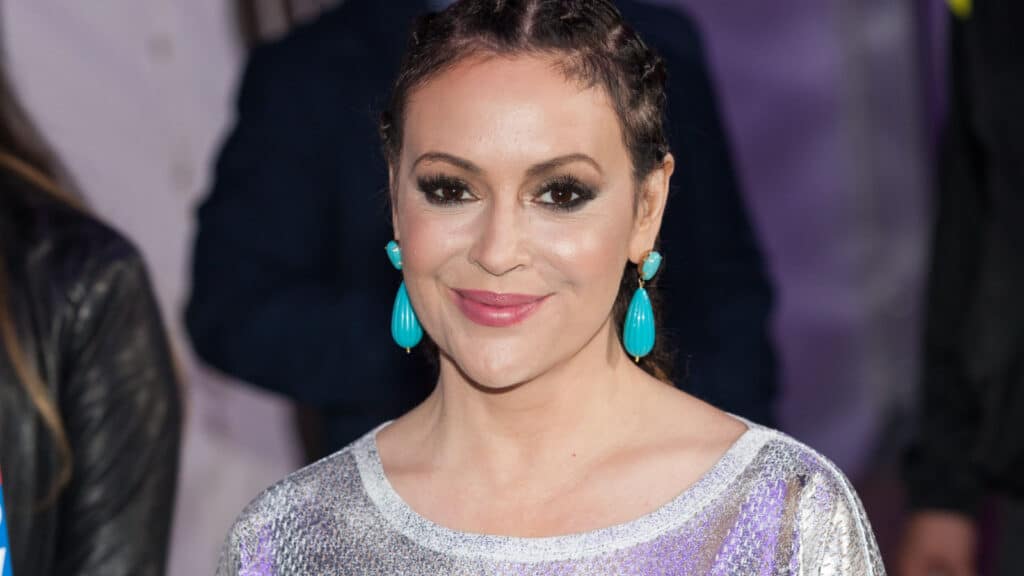
Alyssa Milano is pushing back on that idea in a new essay on her Substack newsletter, The “Elite” Myth and the GoFundMe Outrage. Sharing the piece on social media, she wrote, “If your scroll today needs nuance: here’s a breakdown of the ‘elite’ myth and GoFundMe outrage. Read more at the link in my bio.”
‘Elite’ doesn’t mean what people think it does
Milano argues that a lot of people still picture actors through an old-school lens: long network seasons, syndication checks for decades, and a single hit show that sets you up for life. That era is mostly gone.
Streaming reshaped the business into shorter seasons — often eight to ten episodes instead of 22 — and smaller residuals. SAG-AFTRA’s own posts have said that less than 10% of its roughly 170,000 members earn enough to qualify for the union’s health insurance in a given year.
In other words, visibility is not the same thing as wealth. A recognizable face from a ‘90s teen drama or a current streaming hit doesn’t guarantee anything close to billionaire money, especially after years of pandemic shutdowns, industry slowdowns, and back-to-back strikes.
Milano also points out that the “elite” label tends to get slapped on actors loudest when they speak up about politics, reproductive rights, LGBTQ equality, voting access, or labor issues. Turning working performers into some imagined ruling class is a handy way to wave off what they’re actually saying.
‘Passing the hat’ — even when the person is famous
The GoFundMe for Dane was launched by friends to support his teenage daughters after his ALS battle and death, and has raised well over $400,000 as of late February; the platform has confirmed the campaign is legitimate.
Van Der Beek’s friends and family saw similar generosity — their GoFundMe has pulled in more than $2 million following his death, even as online debates broke out over his Texas ranch and whether the family “deserved” that level of help.
If that sounds familiar, it’s because this isn’t the first time a celebrity-adjacent GoFundMe has turned into a culture-war flashpoint. Earlier backlash over Milano sharing a fundraiser for her son’s baseball team trip to Cooperstown sparked think pieces and social-media pile-ons about whether a working actress should ever ask followers for help.
Milano’s argument now is simple: what friends did for Dane and Van Der Beek is something communities have always done. When someone is sick or grieving, people “pass the hat” — in church basements, union halls, group chats, and now on crowdfunding sites. Choosing to give money to a family you feel connected to, even because you loved Grey’s Anatomy or Dawson’s Creek, isn’t some moral failure. It’s optional generosity.
The bigger question, she suggests, is why that generosity triggers so much suspicion when the person at the center is recognizable, but not when it’s a neighbor down the street.
Who the real ‘elite’ actually are
Milano is blunt about where she thinks the word should be pointed: not at actors trying to keep health insurance or cover medical bills, but at the people cashing eight-figure bonuses while everyone else fights for residuals and basic protections. That critique echoes the issues at the heart of recent Hollywood strikes, where performers pushed for better streaming pay and guardrails around AI.
None of this means you have to donate to every GoFundMe that crosses your feed. But Milano’s essay asks readers to be honest about who actually holds power, and to stop treating compassion like it needs to be means-tested first. As she puts it, “compassion should not have a means test.”
If your feed has been full of GoFundMe debate — and especially if you grew up watching Dawson’s Creek and are now watching that cast navigate real-world tragedy in public — Milano’s full breakdown is worth a read. You can find it on her Substack, The “Elite” Myth and the GoFundMe Outrage.
And if you’re already thinking about how we treat each other online more broadly, you might also like a recent story digging into the everyday behaviors people say it’s time to finally outgrow.
‘It’s 2026 — Grow Up’: People Are Calling Out the Habits We Need to Finally Stop

One Reddit thread asked, “Now that it’s 2026, what’s something people need to stop doing?” and the answers went way beyond “stop writing 2025 on your checks.” From believing everything they see online to Ozempic trends, people had a lot to get off their chest.
Read more: ‘It’s 2026 — Grow Up’: People Are Calling Out the Habits We Need to Finally Stop
24 People (and Things) Who Became Unpopular for No Good Reason, According to the Internet
From pop stars to movie villains, here are the folks many say got unfairly dragged.
Read more: 24 People (and Things) Who Became Unpopular for No Good Reason, According to the Internet
These are the 10 Most Influential Gen Z Celebrities Right Now, According to New Data

A new report analyzed net worth, search volume, media coverage, and social influence to identify the biggest Gen Z stars.
Read more: These are the 10 Most Influential Gen Z Celebrities Right Now, According to New Data